Monday, September 25, 2023

Sources

       Relative, reliable and, reproducible are topics which often arise during one's family tree climbing adventures. Having a surname like JONES, perhaps, brings these topics to the forefront frequently.  What confidence do you have regarding that family tree you are trying to plant? From Kentucky, to Virginia, to London, to Kent, to Rochester, to St. Asaph, to Llanfair Dyffryn Clwyd, and now to this place called Llwyn-Ynn you ask? Well, here are some sources to Llwyn-Ynn (Onn).

      From Clwyd Powys Archaeological Trust, Curatorial Section, dated 5/5/2006: PRN 17810 - Llwyn-ynn Hall, Listed Building 781 (11), NRG : SJ1323053390 (SJ15SW), Unitary authority :- Denbighshire, Community : - Llanfair Dyffryn Clwyd.

       "In former parkland 2 km south of Llanfair Dyffryn Clwyd, reached from the A525 via Llwyn-ynn lodge. History The main house was of Jacobean character. The surviving wing is probably of the late C17 and may possibly date from improvements of 1672, a date said to have been displayed on the house."

       " Llwyn-ynn hall was mostly destroyed prior to 1985, all that remains being an east wing which is clearly identified in the Royal Commission Inventory as a service wing to the main house. The site of the main house is now void." 

       "Exterior The surviving part consists of an L shaped C17 timber framed building and a stone link block of uncertain date. The timber-framed part stands on a high stone plinth, has a gable to the south and another to the east, slate roof with dormer and a tall stone chimney. The timber framing is square and three panels high with top corner braces. The corner posts of the south facing gable are generously jowled. Above tie beam is diagonally panelled. Modern windows. The timber frame to the left flank of the main south-facing gable is in advanced decay. Single storey annex in south east angle."

      "The following is from Cadw's Listed Buildings database"

      "Early C17 and later. Irregular plan and elevation. Stone and timber-framed, with slated roof and central stone stack. 2 storeys, and 2 storeys and attic. Casements and stone mullioned windows transoms and leaded lights. Large turret on west."

      There you have it. All you wanted to know but, too afraid to ask, as some would say in my old Ky home. Next post will give info on the other place some 20 miles east along the high road [see last post]. Will keep those sources coming.


Saturday, September 23, 2023

High Road Around World's End

       My 10th generation grandfather down from the top, Gruffydd (JJ-1), would have been the first to reach his manhood at Llwyn-Ynn. Grazing cattle and sheep would have been one of his daily activities starting at a very young age. Learning the sword and spear would come along the way and, starting in earnest at age 14 years. Lloyd writes in his discussion of "WELSH SOCIETY IN 1200" (p.170), "They roamed their hills barefoot and thinly clad, slept in their day clothes on the hardest of couches, and never bemoaned the loss of a dinner." (p.175) Wow, what a life!

      Now Llwyn-Ynn and Llwyn-Onn were located some 20 miles apart along the paths leading above the north side of World's End. The following figure has been shown before, [post of 24 May 2022], and is now shown to give again the big picture of the geographic area being discussed.

      You can see the area circled in green surrounding the ground at the base of Mt Eglwyse. In my Reader's Guide Touring Britain 1992, describing World's End it states [p.158], "Limestone crags tower above wooded Eglwyseg valley. Remote and beautiful...".

      Just below Ruthin about two miles is the summer home Llwyn-Ynn. To the east is Wrexham the location of the winter home Llwyn-Onn. The following display shows the route traveled on the north side of World's End.

      You can follow the road south from Llanfair Dyffryn Clwyd [location of Llwyn-Ynn] paralleling Offa's Dyke Path to its east crossing together at Peny-stryt. It continues east through Bwichgwyn, and then southeast to Wrexham [location of Llwyn-Onn]. Wow, this path from summer to winter is along the high road of World's End.


Monday, September 18, 2023

A World in Crisis

       Understanding the dynamics of life that surrounded our ancestors from many years ago, often involves reading books that were written to help our insights. The days of William I [1066-1087 A.D.] were certainly such a time for my Jones surname folks. Iorwerth Fychan (JI-1) the first of LLwyn-Ynn and, Gruffydd (JJ-1) the first to grow up there, generated many questions from my genealogy tree climbing exploration. The following books helped me grasp a clearer insight. The covers of my copies are shown.

      From New Years Day England 1066, to New Years Eve England 1066, this text covers only the first year of the great invasion [pp.11-197]. Discussing only the first year in this time seems like a good place to start. First published by David Howarth in 1977, Dorset Press, a comment by The New Yorker was "A model of scholarly popular history." 

      Without bias is generally not achieved, recognizing that it is the victor who writes the history books. But, the next book by R. Allen Brown on its cover folded inward states, "...Normandy and England, the causes, events, and results of the Conquest are examined without bias." 

      First edition was published 1968, and the cover shown above is taken from the second edition published 1985 by The Boydell Press, Woodbridge. My particular attention was drawn to p. 146 where the story of a Norman minstrel, by the name Taillefer, was told at the day of battle 1066. The surname is spelled various ways, Taliafo, Tolliver, Taliafro, and Talifer, but most often Taliaferro when their surname appears on my side of the great pond with my family many, many, times.

      Perhaps the text with the widest range of topics is written by Robert Bartlett which includes chapters on the course of life, cultural patterns, religious life, towns and trade, and the rural foundations. 
      It was published 2000, by Oxford University Press. Items like the family tree of William I (p.5), yield per seed sown on Winchester estates 1211-1225 (p.305), and towns ranked by contribution to the urban aid of 1130 (p333) are presented among the 660 pages. Wow, what a resource for the dynamics of the time. 
      The Norman knight was generally considered the most powerful warrior of his day. The next text presents this topic with pages of colored examples taken from this period of time. Page after page the illustrations are displayed, a picture book of the day. Written by Christopher Gravett and David Nicolle and published by Osprey Publishing in 2006, writing this book, it would have been fun picking out all the images.
      The chapters on the Norman stone castle are extremely helpful trying to understand what it might have been to live in one. A chronology from 911 A.D. to 1287 A.D.  is outlined on pages 14-17. The principle of feudalism is discussed helping to understand this complicated topic. Just loved all the pictures.
      The references for this time period would not be complete without a book about Henry II. He began his reign 1155, and was the invader into Wales when my Jones surname family made its move to LLwyn-Ynn. The politics, government of England, the Church, and the Angevin commonwealth [those from Normandy] are discussed among its 669 pages. What a deal. By W.L. Warren, it was published 1973, Butler & Tanner Ltd, London. A little heavy reading, but using the index as a guide to the subject one seeks, pp.669-693, it provides a good source of knowledge. 

     There you have it, my many texts of the day used often to assist my understanding of a world in Crisis.


Sunday, September 10, 2023

Home Base Summer and Winter

      Foundational to one's existence is the family. From pre-natal, natal, to infancy and early childhood, one begins to recognize and develop their own view of the environment that demands one's attention. The home is usually the place one starts to learn about their immediate surroundings. My ancestors, Jeuaf (JH-1) to Iorwerth Fychan (JG-1), moved their new townlands [in Welsh called tref ] to a place they called Llwyn-Onn. For many years this was believed to be one location in the Vale of Clwyd. A book by P. Thoresby Jones, published 1938, and titled Welsh Border Country, when discussing his travels through the Vale of Clwyd, p. 103, states "Leaving Llanfair D.C. (as it is familiarly called), the Wrexham road undulates to the head of the Vale, passing near half-way the gate of a long drive leading to the lovely though unfinished Elizabethan mansion of Llwyn Ynn...". Say What! Here it is spelled "Llwyn Ynn" and among my many other notes written "Llwyn Onn"? What you say... oh yes, a map is needed to check:

      Here is such a map. Llanfair Dyffryn Clwyd is shown directly in the middle of the map in large letters at the top. The Llwyn-ynn Hall location is shown at the bottom of the image. "Llwyn-Ynn" it is. The road traveled and the gate described by old Thoresby in 1938 can be imagined. The map was taken from http://www.streetmap.co.uk in 2007. What's up with this?

      Digging around my selves of books (lots of books here), a tour guide titled Frommer's Scotland and Wales on $50 A Day, by Darwin Porter, published 1989, on page 532, gives the following under the topic 11. Wrexham, "Good accommodations is found at Llwyn Onn Hall (Ash Grove Hotel), Cefn Road, Wrexham, Clwyd...Named after the groves of ash that still grow around it, this historic home was originally built from 1702 to 1706...The establishment lies within 60 acres of grounds, about 1 1/2 miles east of the town center of Wrexham...". Another map is shown below.

      Llwyn-Onn here and, Llwyn-Ynn on the first map above. Two distinct places with the same meaning (translation) but, some 15 miles apart. Llwyn-Onn is on the eastern side of that big ditch called Offa's dyke, and Llwyn-Ynn is on the western side. Also remember that Wat's dyke runs right through Wrexham. [see posts March 23, 27, and 28, 2022].
      By this time it came to mind that the ancient Welsh had a summer home (hafod) and, winter home (hendref). The winter home was the main townland of the family (old settlement). It was generally considered the original settlement of their ancestors. Each kindred group had claim upon the arable land, the meadows, the woodlands, and the grazing lands. At the main home, plowing and planting took place. The summer home (May Day through July) was the grazing land for the herds. An article discussing the ancient ecclesiastical parish of Llanfair Dyffryn Clwyd stated that the earliest evidence of human activity was the discovery of two stone axes of late Neolithic or early Bronze Age. A Bronze Age axe was found in about 1860 on land belonging to the Llwyn-ynn estate. Can you believe it??? My Celtic ancestors were losing things way back then! [article found 2006 at http://www.capt.org.uk]. Perhaps this is one of the reasons my Jones surname ancestors chose this name "Llwyn-Ynn (Onn) which was carried down through the family tree for generations. They were returning to home base for the summers and winters yet to come.

      P. S. Here is a figure of what a bronze age axe might have looked. Taken from The Story of The Isle of Man, Volume 1. The Earliest Time To 1406, by C.W. Airne, published 1949, p.21.


Saturday, September 2, 2023

An Eyewitness Account

      For the genealogist, an item recorded during the corridor of time that is being researched is paramount to the reliability and accuracy of the information being collected. My families' time frame, Iorweth Fychan (JI-1), is 1175 A.D. +/- 10 years, when they moved to a new geographic location that was to begin a new era for those yet to come. [see last post "Of Llwyn-Onn"].  A fellow named Giraldus Cambrensis [better known as Gerald of Wales] recorded his personal trip around Wales taken during the year 1188 A.D. A text from the Latin was published by Penguin Classics, translated with an introduction by Lewis Thrope, in 2004. Thorpe first wrote his text in 1978. The cover of my copy follows.


      Gerald's own genealogy is given on page 11, and it would seem he was 75% Norman. How abouut that? On page 251 under ancient genealogy he writes:   "The Welsh esteem noble birth and generous descent above all things, and are therefore, more desirous of marrying into noble than rich families. Even the common people retain their genealogy, and can not only readily recount the names of their grandfathers and great-grandfathers, but even refer back to the sixth or seventh generation, or beyond them..."

      Sounds a lot like my post of August 18, 2023 which was taken from a Welsh genealogist, Nicholas, Vol. I, p. 355, written some 690 years later [see last post]. But hey, here is an eyewitness account.

Monday, August 28, 2023

Through The Ages: " Of Llwyn-Onn"

       Titles given to locations often have special meanings, especially to those who choose the name. My Jones surname ancestors selected a name that became a symbol for generations to come. Translated from the Welsh, it means "Ash Grove". Now to give an idea of the number of generations so tagged, the figure taken from a well-known Welsh genealogist is shown [Nicholas, Vol. I, p.355]. The generations that were to identify with this descriptor is shown by the red circle with pink marking. 

      Wow, just count the generations that followed Iorwerth Fychan (JI-1), who is described as being the first named as of Llwyn-Onn in the county of Denbighshire [p.354]. That's right, the next 15 generations!  There must have been something very special about this name and, a significant reason why it was passed down from one generation to the next for more than 250 years. Hum, let's see. First is the Ash tree.
      It looks like any other tree to me and, it was valued at the bottom of the lists for trees in the Welsh laws of the day [see post Well Stockaded of August 15th]. It certainly could be used as lumber, but an Oak tree would be much stronger. It could be used for firewood and, it is recognized as producing fewer sparks at the fireplace, but a grove of them.  A grove is defined as a small wood without under-brush and, why clean it out if you were only going to chop it down and burn it up? Got to be something else it would seem to my reasoning? What about a memory in song? Here are the words to an ancient Welsh song and, you know my Welsh ancestors loved to sing. Also, my Dad was the song leader for more than 50 years in the Church of Christ of my childhood. In those days, A cappella was the only way allowed to sing [see post of November 3rd, 2010].
                                                                                                                                                                            The words to an ancient Welsh song titled, The Ash Grove:
                            
                        "Down yonder green valley, where streamlets meander, when twilight is fading
                          I pensively rove or at the bright moontide in solitude wander, amid the dark
                          shades of the lonely ash grove; 'Twas there, while the blackbird was
                          cheerfully singing, I first met my dear one, the joy of my heart! Around us for
                          gladness, the bluebells were ringing. Ah! then little thought I how soon we
                          should part 

                          Still glows the bright sunshine o're valley and mountain,
                          still warbles the blackbird its notes from the tree; still trembles
                          the moonbeam on steamlet and fountain, but what are the beauties of nature
                          to me? 

                         With sorrow, deep sorrow, my bosom is laden, all day go mourning in search
                         of my love; Ye echoes, oh tell me, where is the sweet maiden?

                                            "She sleeps, 'neath the green turf down by the ash grove"
                   
   Seems like a song to remember through the ages down the branches of my Jones surname family tree.                                        


Thursday, August 24, 2023

Chronology of Death

       Date of birth and, date of death are two events that every genealogist hopes to record correctly on each individual placed among the branches of their family tree. Now, recording only the date of death for each individual might be a little suspect as to the goals being utilized. However, the recorders of the earliest Welsh genealogist seem to give only dates of death. What is up with this, was often my thought, when climbing around the branches of some of the earliest generations of my own Jones surname family tree.

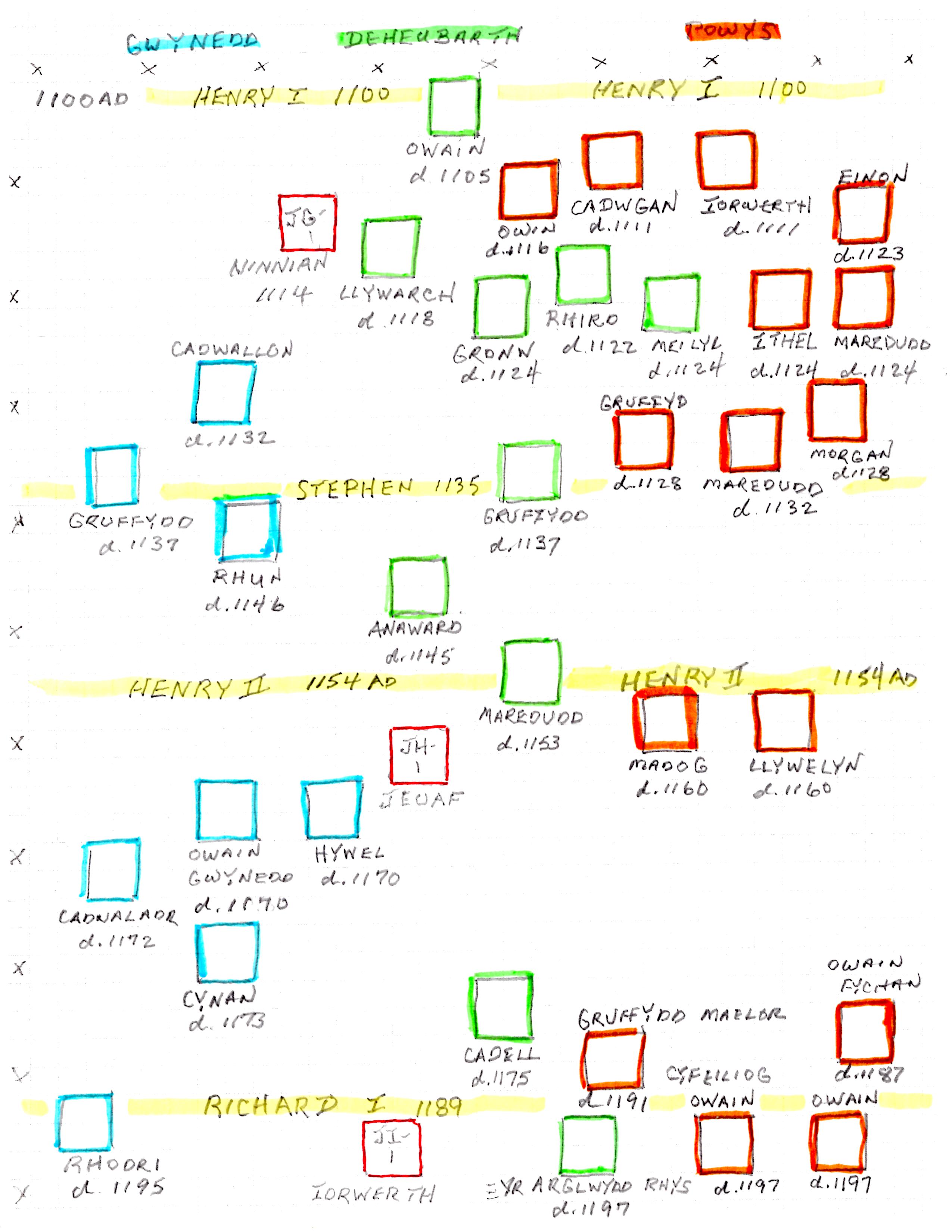
      To illustrate this phenomena, the following charts are drawn to show the first 400 years of Welsh kindred leadership as translated by Lloyd (see post July 6th, 2023). The districts of Gwynedd (Royal Tribe I) colored blue, Deheubarth (Royal Tribe II) colored green and, Powys (Royal Tribe III) colored orange, are represented by the squares drawn for each individual named by Lloyd pp. 273 - 277 titled "Genealogical Tables". Each chart is drawn in chronological order for ten year periods. Significant events are listed in yellow.  My family, from Tudor Trevor (JC-1) to Iorwerth (JI-1), are represented by the squares outlined in red. So, hold on to your seat belt and let's go, starting from 900 A.D.! 

      The first chart begins with the law giving years of Hywel Dda (EB-15) and end with his death 950 A.D. He died representing Deheuabarth (Square colored green), and his son-in-law Tudor Trevor (JC-1) had already died two years before. It was not until the sons of Hywel Dda (EB-15) began their own quest for recognition that the laws of cooperation began to decay. Folks from the north seem to battle against folks from their south trying to get their date of death into my chart. 

      Just after the start of the next 100 years [1039 A.D.], a fellow named Gruffudd ap Llywellyn (ED-28) made his own way upon the stage. He certainly made a distinct pathway around all the kin groups until his death in 1063 A.D. led by an individual named Harold II (M-39). This Harold has been portrayed often as "the last of the Saxons" [see page 494 in the book by Ashley discussed in post 20 Feb. 2023]. Now the walls of all came tumbling down after 1066 A.D. when those French speaking folks from across the Channel introduced William I (SD-7). You can certainly see the impact that this had upon all the dying, with Powys now coming into the charts along with all those green colored fellows. Cynrig (JF-1) was killed 1073 A.D. just about in the middle of all the other deaths.

       Henry I (O-3) [p. 508 Ashley], gave his debut the very start of the next 100 years. The death dates took their climb to new heights (n=33) almost totaling more than the first 400 years together. Jeuaf (JH-1) was given his name by its Norman spelling, and the death chronology shows why Iorwerth (JI-1) might have wanted to make the family's move to the hills [see last post]. The last chart to be shown starts in the year 1200 A.D.  These dates begin after the next in my family tree are to be named.


      You can see that the dates of death are at their highest number (n=38) after Henry III (SB-19) started his play in this dance of death. [Ashley p. 531] My ancestors are shown only by their code numbers at this point but, their names are yet to be listed. The Welsh genealogists began their kindred family trees starting around 1150 A.D. and, you can certainly see why it could be called a chronology of death.