Showing posts with label Army of Occupation. Show all posts

Thursday, March 12, 2015

From The Air

Prior to the close of WWII, the American industrial complex had produced the war machine.  Tanks, trucks, ships, arms, planes, and all kinds of war materials were made at remarkable speed.  What happened at the end of WWII to all this stuff.   The planes remaining in Germany were blown up all in a row. 

My Dad participated in these activities as part of the Army of Occupation, Germany.  He states that Germany POW's [prisoner of war ] were driven to the air field each day.  They were given TNT in square blocks (about the size of a shoe) that were placed on the wings of a plane.  This was after each plane was stripped of any usable parts. [Platinum from the engines were the major item.]  The following picture shows such a plane as it was ready to blow.


Not much is left to see.  Dad was responsible for setting off the charges some 100 yards from the explosion.

To get a scope of the extent of this process, the following picture was taken from the air.  It shows the field as it stood in 1946.


Planes, planes, and more planes, all lined up in a row, waiting for their final destination.  What a picture from the air it is.  To have survived the war and be blown apart at the end.

Friday, January 23, 2015

Watersheds


There it stands.   Strikingly beautiful or impressive it is.  Some consider it the most spectacular isolated mountain in the world all 14,691 feet (4,478 meters).  Part of the Alps' (which serve as the European watershed) it stands proudly.   In 1946 my Dad took this picture.  The Matterhord it is called.   As part of the Army of Occupation, he was given the keys to a dark room where he spent time developing his own pictures.   The keys were to be passed on to another when his own time was completed.   Such is the picture above. 


 Here he stands most likely on the same day he took the picture of the Matterhorn.  A camera case hangs from his right shoulder.  A snow ball in his left hand. [He is left-handed]  A watershed of his own I imagine.  After this time as one in the Army of Occupation what will life hold for me?  Do I throw this snowball, or do I just let it melt in my hand?   Hum...questions of life are often watersheds.  In 1946, the world had just finished its own watershed.

Monday, September 1, 2014

A Bavarian Lake 1946

Third US Army "Tours" it states on this post card from 1946.


"Koenigssee (Royal Lake) near Berchtesgaden, the most beautiful of Bavarian lakes, is entirely surrounded by steep walls of rock.  The lake is 582 ft. deep" is the information on the back of this card.

I don't know how many Bavarian lakes there are.  Does anyone know?  This is one pictured from 1946. My Dad brought this card back home.  A beautiful memory it is.

Sunday, August 10, 2014

Upon The Roof

Travel to Switzerland after time in war torn Germany 1946 must have been special.  A collection of post cards kept by my Dad have been shown in many of the last posts.  This post card is "Roof Garden - Restaurant".  Up on the roof I thought.  It is taken at "La Residence - Geneve", and one can see the steeples of a large church in the background. [upper left]  It would seem a good place to eat and gaze about the world of Geneva in a peaceful setting.  I suspect that there were not a lot of roofs still standing on the other side of the border.


The next picture shows my Dad standing on another roof.  It might be viewed as a "roof" of the world.


High in the Alps... mountain peaks rising in the distance...a snow ball in the hands instead of bullets...who would have guessed snow balls instead of bullets...upon this roof.

Sunday, August 3, 2014

Lake Geneva 1946

On leave from occupied Germany 1946, my father collected a number of post cards from his travels.  A trip around Lake Geneva seems to be one of the activities.

The "Port du Mont-Blanc" seems the place you got on board to travel around the lake.  The ship with the central smoke stack seems the one to take.  "Mont-Blanc" towers centrally in the picture shown above.
Moving on down the bridge shown above, you must have come the port from which the ship boarded.  The position of "Mont-Blanc" has moved to the left of center.  The fountain is now visible spraying into the air.
A little wider angle shows the ship leaving the port.  The card reads: "Geneve, La Rade, le Jet d'Eau et le Mout-Blanc."  Sort of the big picture I suspect.  "La Rade" may have been the name of the ship.  The fountain is called "le Jet d'Eau", and of course "le Mont-Blanc" is shown.
On the return trip you must have passed closer to "le Jet d'Eau" which is stated on the card at "90 m".  Lots of buildings are around the lake, and "le Mont-Blanc" stands proudly in each picture.  Hum...Lake Geneva 1946...the white mountain...and a fountain of hope...wonder how it has change since this trip around the lake.

Sunday, July 13, 2014

Chateau de Chillon 1946

Past postcards filled a box kept by my father since 1946.  The "Great War" had just ended, and he was part of the "Army of Occupation" that resided in Germany after the war.  On leave, he visited Switzerland, and collected a number of postcards.  The following are two of the "Chateau de Chillion".


Located on the shores of Lake Geneva, near Montreux, it has occupied a place in history since the Bishops of Sion found a site many years ago.


The dungeon has been home to a number of distinguished guest.  In 1946, my Dad was at least a visitor.

Tuesday, June 17, 2014

Hotel Jura 1946

Arriving Basle, Switzerland after months in war ravaged Germany 1946, must have been a delight.  My Dad kept a shoe box full of post cards and pictures of the days spent here.  Hotel Jura must have been one special stop over since the following was kept:


It must have been a hotel card to write your name and room number, but you can see that Dad did neither.  It is stated "Opposite main railway station"...well here is a post card he kept...


I assume it is the main railway station at this time.  Very impressive indeed it is...just across the German border.

Now if you needed a watch just "turn over please"...


Here is a list of  "qualified watch maker's shop", and a list of the members of the Swiss Watchmaker's Association of 1946.  There are lots of names here, and there must have been lots of watches.  If you could not afford a watch, the card suggested buying  "Swiss Postage Stamps  as Souvenir".   Also, there were two "Movie-Houses" that presented "the best Original American Films in your own lingo."  Wonder what was showing in 1946 for the Hotel Jura?

Monday, June 2, 2014

Still on Earth

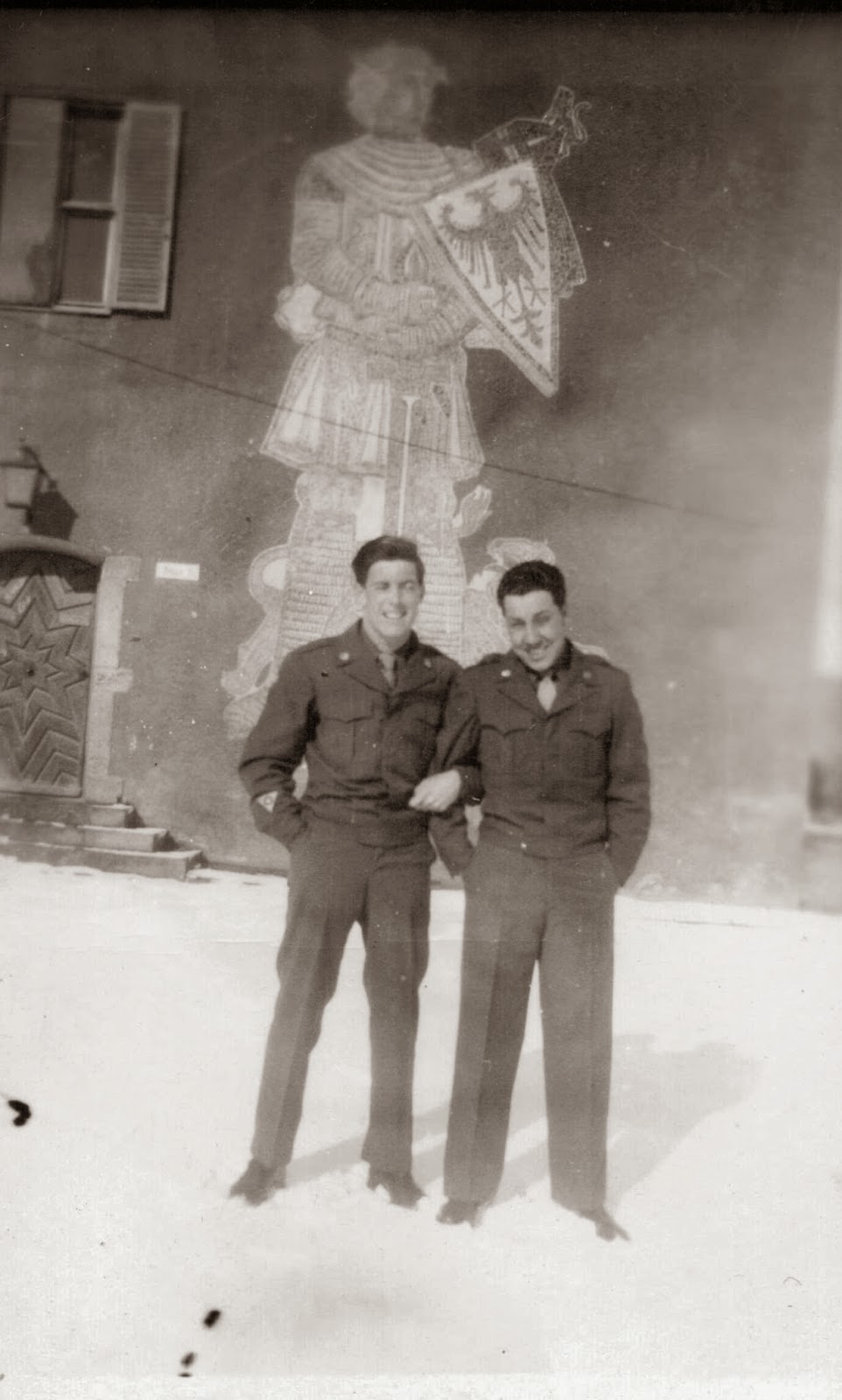
Snow had fallen when this picture was taken in 1946.

It was taken of my father and his friend standing in from of the building that was housing them as part of the Army of Occupation in Germany.  They are standing in front of a two story tall figure of a knight holding a shield.  This figure had been painted on the outside front of the building at some point in time as a symbol to those passing.

The central figure on the shield is the eagle.


In the book "A Guide to Heraldry" by Ottfried Neubecker, it states that the eagle and related species are the most widely used symbols for God and heaven. (p.110)  He states that the Hittites used the double eagle as a symbols of sovereignty.  He goes on to state that Emperor Charlemagne (800 AD) used an "imperial eagle" to symbolize his sovereignty, and it would seem that ever since this time it had become the emblem of Germany. 

Well on this snow covered day in 1946, I wonder how many folks were between "God and heaven".  At least these two fellas were still on earth.  


Wednesday, May 28, 2014

Angel of Peace


My Dad took this photo in 1946.  He was part of the Army of Occupation (Germany) which officially began May 5, 1945 and spent almost two years in southwest Germany.  On the back of the picture is written:
                                       "Angel of Peace - can't you see this in Germany."

 It must have been with some sense of irony to find anything still standing [see last post "No Pot to Pee In"] little lone a statue titled "Angle of Peace".  Dad states he does not remember exactly where this statue was located, but his hand written note still strikes a cord on the strings of history.  Does anyone know the location of this statue if it still exist?  There is a single individual sitting at the base...I wonder if he is thinking is peace really here.

Sunday, May 4, 2014

"No Pot to Pee In"


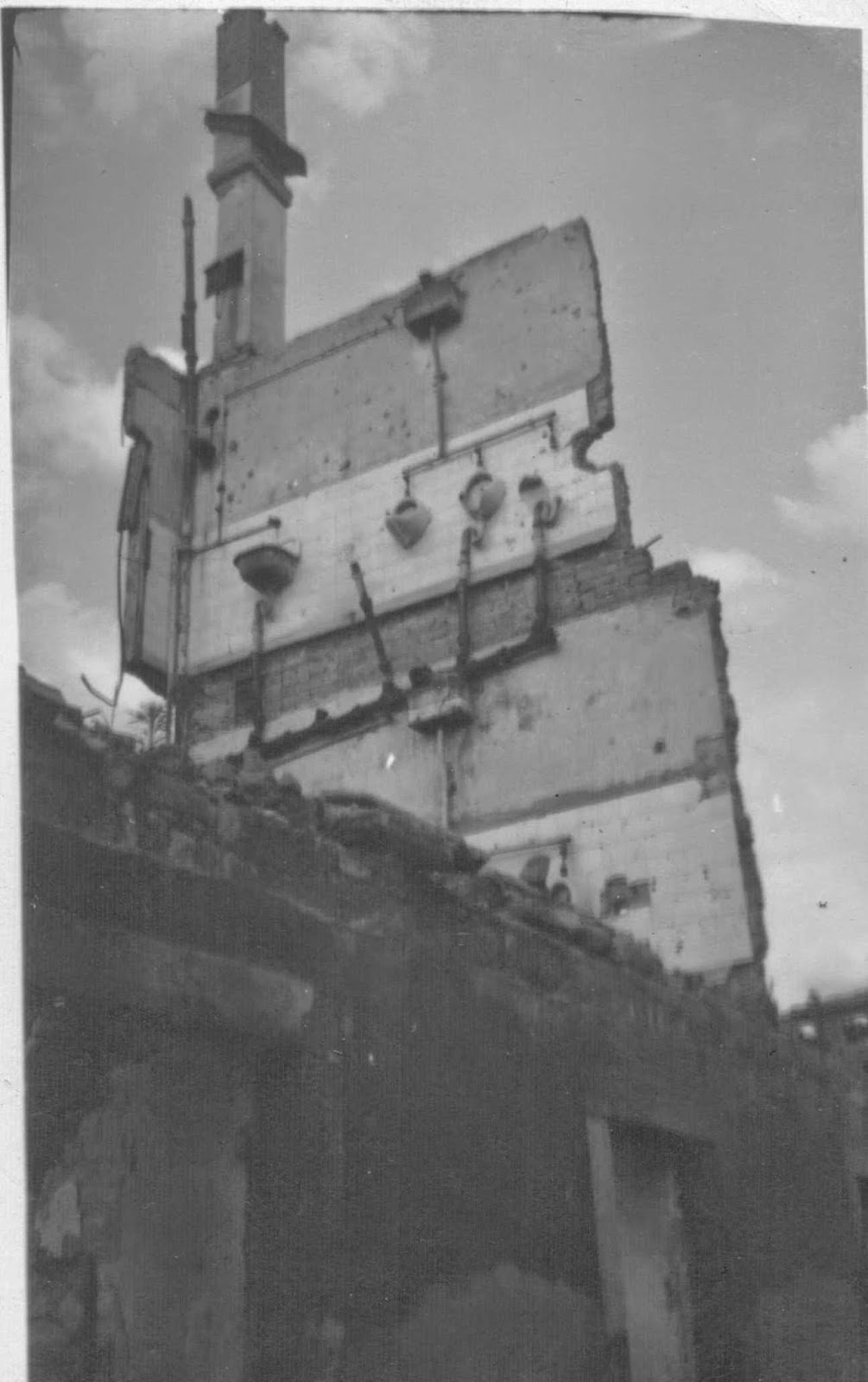
It would have been Germany 1946.  My Dad took this picture and written on the back is:

                    " This bathroom is all left of a bombed building.  Look for yourself - "

For most of Germany, the War had left not much standing.  The Army of Occupation was arriving, and trying to make some order out of the chaos was the job.  "No pot to pee in..." as they would say in Kentucky.  It is had to imagine such a world with only a few walls standing.  Ironically it would have to be a bathroom...urinals still attached to the wall...but no pot to pee in!