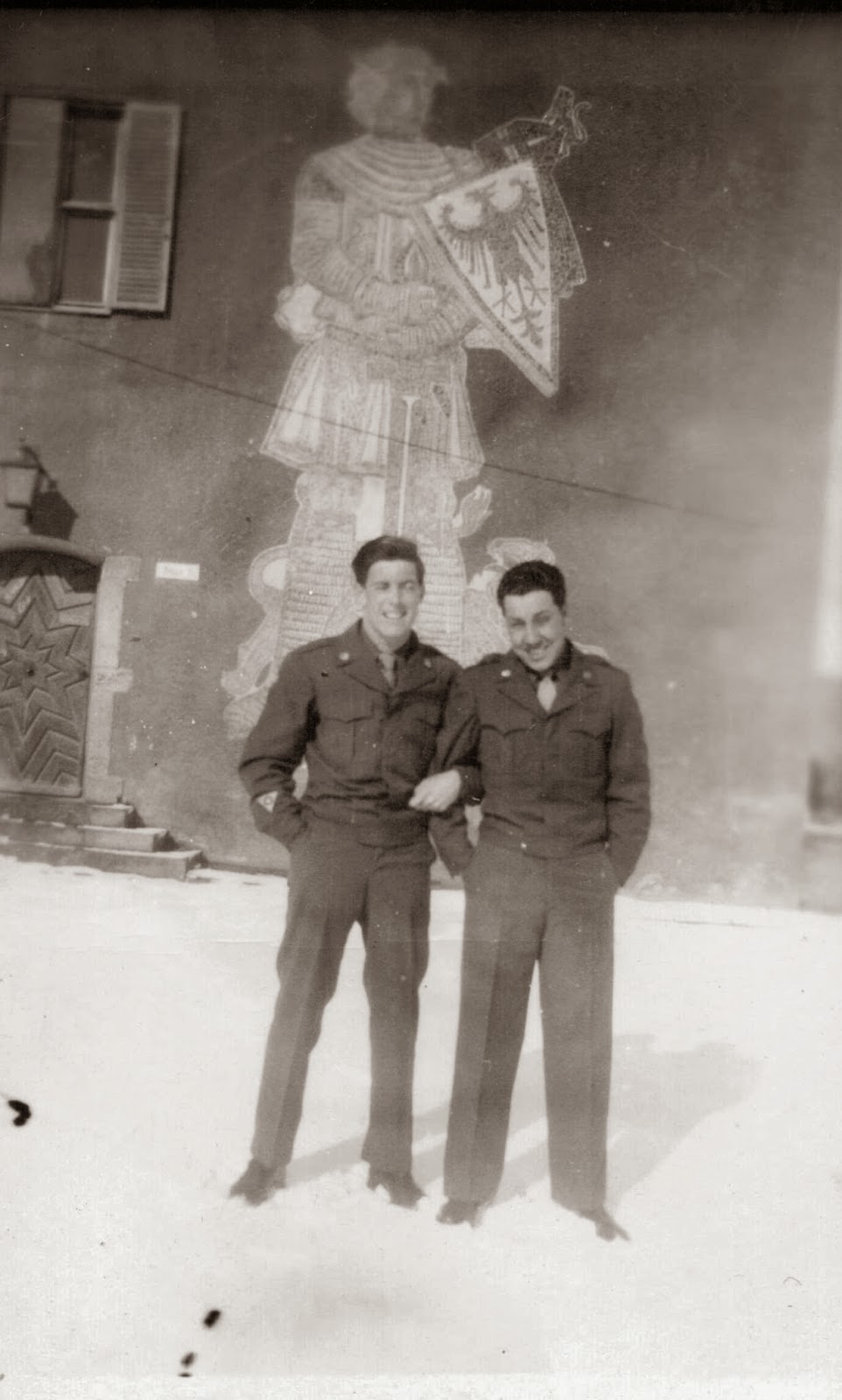
Snow had fallen when this picture was taken in 1946.
It was taken of my father and his friend standing in from of the building that was housing them as part of the Army of Occupation in Germany. They are standing in front of a two story tall figure of a knight holding a shield. This figure had been painted on the outside front of the building at some point in time as a symbol to those passing.
The central figure on the shield is the eagle.
In the book "A Guide to Heraldry" by Ottfried Neubecker, it states that the eagle and related species are the most widely used symbols for God and heaven. (p.110) He states that the Hittites used the double eagle as a symbols of sovereignty. He goes on to state that Emperor Charlemagne (800 AD) used an "imperial eagle" to symbolize his sovereignty, and it would seem that ever since this time it had become the emblem of Germany.
Well on this snow covered day in 1946, I wonder how many folks were between "God and heaven". At least these two fellas were still on earth.
Showing posts with label symbols. Show all posts
Monday, June 2, 2014
Thursday, June 27, 2013
A Stitch In Time
A counted cross-stitch is what it is. Done with Aida fabric, embroidery threads, needle, backing felt, and a full charted set of instructions. What a deal! My middle daughter, Lesley, with her heart and hands made this for me as a symbol of our family's heritage...the Welsh Dragon, the heraldic symbol of Wales.
Now a symbol is something that stands for or suggests something else by reason of relationship, association, or convention. A red dragon...hmm...where in the world did this come from in the annals of history?
The earliest reference to a red dragon connected to the legends of Wales can be found in the writing of a Welshman of the early ninth century. [ ca. 829 AD] The writer introduces himself as "Nennius", and the formal title is Historia Brittonum or the "History of the Britons". He certainly had a chip on his shoulder because in his introduction he states:
"I, Nennius, disciple of Elvodugus, have endeavoured to write some extracts which the stupidity of the British nation had cast away..."
Well anyway, in his book, part III, chapter 39 - 42, he gives a fairly lengthy story regarding the building of a fortify city [citadel] by a fellow named Vortigern. After traveling "...far and wide..", he came to a province called "Guenet", and "...having surveyed the mountains of Heremus, they discovered, on the summit of one of them, a situation, adapted to the construction of a citadel." This of course is believed to be the mountain range of Snowdon.
To make a long story short, every time Vortigern built a foundation, it disappeared in one night. Frustrated, he got some help from a fellow named "Ambrose (in British Embresguletic)" who uncovered a "pool" with two vases in the pool. The two vases contained two tents, that contained "two serpents, one white and the other red". After a lengthy struggle, the red serpent "expelled the white one from the tent".
Ambrose explained "...this wonderful omen..." as follows:
"I will now unfold to you the meaning of this mystery. The pool is the emblem of this world, and the tent that of your kingdom: the two serpents are two dragons; the red serpent is your dragon, but the white serpent is the dragon of the people who occupy several provinces and districts of Britain, even almost from sea to sea; at length, however, our people shall rise and drive away the Saxon race from beyond the sea, whence they originally came..."
Wow, the red dragon of Wales...our first stitch in time.
A translation of this text can be found at Medieval Sourcebook: Nennius: Historia Brittonum, 8th century, for those who would like to stitch together the rest of the story:
http://www.fordham,edu/halsall/basis/nennius-full.html
Now a symbol is something that stands for or suggests something else by reason of relationship, association, or convention. A red dragon...hmm...where in the world did this come from in the annals of history?
The earliest reference to a red dragon connected to the legends of Wales can be found in the writing of a Welshman of the early ninth century. [ ca. 829 AD] The writer introduces himself as "Nennius", and the formal title is Historia Brittonum or the "History of the Britons". He certainly had a chip on his shoulder because in his introduction he states:
"I, Nennius, disciple of Elvodugus, have endeavoured to write some extracts which the stupidity of the British nation had cast away..."
Well anyway, in his book, part III, chapter 39 - 42, he gives a fairly lengthy story regarding the building of a fortify city [citadel] by a fellow named Vortigern. After traveling "...far and wide..", he came to a province called "Guenet", and "...having surveyed the mountains of Heremus, they discovered, on the summit of one of them, a situation, adapted to the construction of a citadel." This of course is believed to be the mountain range of Snowdon.
To make a long story short, every time Vortigern built a foundation, it disappeared in one night. Frustrated, he got some help from a fellow named "Ambrose (in British Embresguletic)" who uncovered a "pool" with two vases in the pool. The two vases contained two tents, that contained "two serpents, one white and the other red". After a lengthy struggle, the red serpent "expelled the white one from the tent".
Ambrose explained "...this wonderful omen..." as follows:
"I will now unfold to you the meaning of this mystery. The pool is the emblem of this world, and the tent that of your kingdom: the two serpents are two dragons; the red serpent is your dragon, but the white serpent is the dragon of the people who occupy several provinces and districts of Britain, even almost from sea to sea; at length, however, our people shall rise and drive away the Saxon race from beyond the sea, whence they originally came..."
Wow, the red dragon of Wales...our first stitch in time.
A translation of this text can be found at Medieval Sourcebook: Nennius: Historia Brittonum, 8th century, for those who would like to stitch together the rest of the story:
http://www.fordham,edu/halsall/basis/nennius-full.html
Subscribe to:
Posts (Atom)


